
A card game for 1 to 2 players
Designed by John Burton
Art created by John Burton using dream.ai
Click here for printable version
Mint Tin Mahjong is a quick but challenging condensed version of Mahjong that can be played by two players or played solo. It takes inspiration from multiple styles of Mahjong including traditional Chinese and American styles, while adding unique new game mechanics for a fresh new take on the classic game.
COMPONENTS (54 Cards)
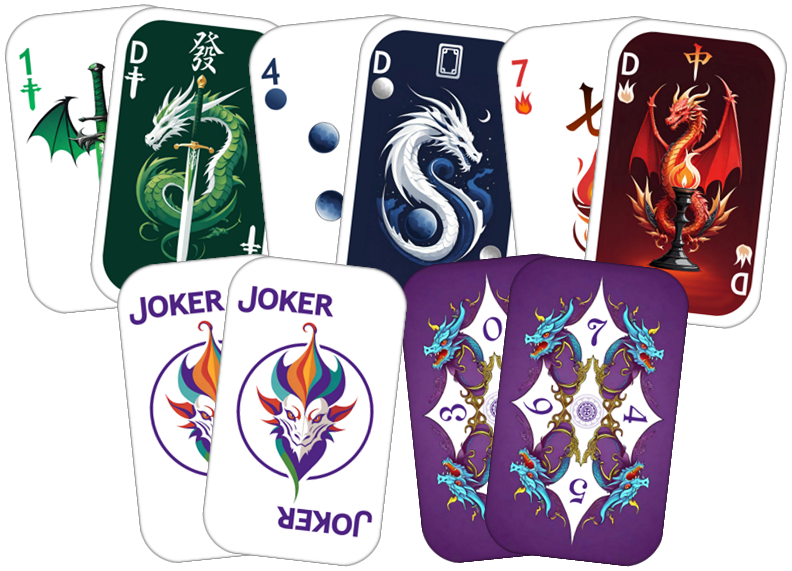
- Sword Suit (4 of each): Numbers 1,2,3, Dragon
- Moon Suit (4 of each): Numbers 4,5,6, Dragon
- Fire Suit (4 of each): Numbers 7,8,9, Dragon
- Jokers: 2 double- sided, 2 with card backs
- Score Cards: 2 cards, 1 for each player
RULES
These rules begin by explaining the two-player version then the solo variant. If playing solo, it is important to read all the rules in full because the solo variant somewhat simulates a two-player game and most of the two-player rules apply.
OVERVIEW: On your turn you simply take a card then discard a card. Your opponent will do the same, and this repeats until someone calls Mahjong! Your goal is to create a winning Mahjong hand with 14 cards that scores at least one point before your opponent. You will score points based on the cards you were able to collect for a winning hand. Play multiple rounds until someone reaches the required points, typically 7.
CLICK HERE TO JUMP TO THE 1P SETUP AND RULES
SETUP FOR TWO PLAYERS
- Give each player a score card to set aside within reach. Turn the card so the 0 is at the top of the card readable by the player.
- Players choose which jokers to use. They can use all jokers, 2 jokers, or no jokers. If using the double-sided jokers, give one to each player at the start of each round. If using jokers with backs, shuffle them into the deck. Set aside unused jokers.
- Use any method to randomly select the first dealer. The dealer will rotate each round.
- At the start of each round, the dealer shuffles the deck and the non dealer cuts the deck.
- The dealer deals each player 12 cards if players start the round with a joker, or 13 cards if they do not.
- Place the deck between the two players face down.
- Leave space beside the deck for a discard pile.
- Players should leave space in front of them to place exposed cards.
OPTIONAL PASS
- The non dealer can offer to pass between 0 to 3 cards to the dealer.
- The dealer will then reply how many cards between 0 to 3 they would like to pass.
- The lowest number of the two determines how many cards the players pass.
- Players then pass the cards to each other placing them in their hands.
- The round is now ready to begin
WINNING HANDS
Before learning how to play, you first need to know how to build a winning Mahjong hand. When you take a card at the start of your turn, you will have 14 cards in your hand. Winning hands must include this 14th card, and they require both a valid CATEGORY and a valid PATTERN of BLOCKS. The category is the set of number cards used. The pattern is the various groupings of identical cards, known as blocks, that are used to build a 14-card winning hand.
BLOCKS: Blocks are groups of between 2 and 5 identical cards. Block types are named as in other styles of Mahjong: Pair (2 cards), Pung (3 cards), Kong (4 cards), Quint (5 cards). Jokers can be used to replace cards in any block except for pairs.
PATTERNS: Patterns are created with combinations of blocks that add up to 14 total cards, using two different block types. Any number of blocks of each type can be used, as long as the total number of cards adds up to 14. Different block types can be used in any order in a pattern.
Below is a list of all the 9 possible patterns based on these rules. This list is for reference only and does not need to be memorized as long as the rule of using two different block types in 14 cards is followed.
One Pair and Three Kongs: 
Three Pairs and Two Kongs: 
Five Pairs and One Kong: 
One Pair and Four Pungs: 
Four Pairs and Two Pungs: 
Two Pairs and Two Quints: 
Three Pungs and One Quint: 
One Kong and Two Quints: 
Two Pungs and Two Kongs: 
CATEGORIES: The category chosen determines which types of cards are used in the various blocks in the pattern. The numbers selected from the category are known as the “set”. For example, the set 4-5-6 can be taken from the Consecutive Run category. Each number in the set must be used in its own block. Number cards cannot be repeated in more than one block.
CONSECUTIVE RUN: 1, 2, 3, 4, 5, 6, 7, 8, 9
CONSECUTIVE ODDS: 1, 3, 5, 7, 9
CONSECUTIVE EVENS: 2, 4, 6, 8
SET RULES: You must use a set of at least 3 consecutive numbers from the category, making 1 block with each number for at least 3 different blocks in your pattern.
WRAP AROUND: A unique feature of Mint Tin Mahjong is that the sequence of numbers in any category “wraps around” to the beginning of the sequence once reaching the end. The Consecutive Run category continues from 9 back to 1, the Consecutive Odds category continues from 9 to 1, and the Consecutive Evens category continues from 8 to 2. This allows sets such as: 7-8-9-1, 6-8-2, 9-1-3 etc. However, numbers still must be in consecutive order, so sets like 1-5-9 or 2-3-6-7 are not permitted.
DRAGONS: Blocks in the pattern that are not satisfied by cards from the category set may be satisfied by blocks of Dragons as long as there is a number block of the suit that matches the suit of the dragon. Dragons can be used with any block type. Dragons of the same color cannot be used in more than one block.
SUITS: There are no requirements for which suits of the number cards are used to make winning hands. However certain combinations of suits and/or Dragons can be worth additional bonus points.
SAMPLE WINNING MAHJONG HANDS:


TWO PLAYER GAMEPLAY
The dealer takes the first turn. Your turn consists of the following steps. Each of these steps will be described in detail below.
- Draw or Call a card
- Swap any jokers if desired
- Discard a card
- The turn passes to your opponent
Players alternate turns until someone draws or calls a card that allows them to make a winning Mahjong hand.
DRAW OR CALL: On your turn, you must either draw the top card from the draw deck, or call the last card discarded by picking up that card and placing it face up in front of you with at least two other cards from your hand that are identical to that card or a joker. These exposed cards are still part of your hand of 13 cards.
JOKER SWAP: Joker Swaps are performed during your turn after drawing or calling a card and before discarding a card. There are two ways to perform a Joker Swap:
- If an opponent has exposed a block with a joker, and you have a card in hand that matches the card that the joker is replacing, pass the joker to your opponent and say “Joker Swap”. Your opponent must pass you the joker and put your card in their exposed block where the joker was. You put the joker in your hand.
- If an opponent has exposed a block with a card that you want in your hand, and you have a joker in your hand, pass the joker to your opponent and say “Joker Swap for…” and say the name of the exposed card you would like to take. Your opponent takes the joker, places it in the exposed block, and gives you the requested card.
DISCARD: Once your turn is complete, discard a card by placing it face up in the discard pile. Players can look at all the cards in the discard pile at any time. Players may choose to place cards in the discard pile so all are visible at all times.
CALLING MAHJONG: If after drawing or calling a card on your turn, the 14 cards in your hand make a valid pattern and use a valid category set, and score at least 1 point, you can call Mahjong. Normally you cannot call a card to make a pair, however if the card is the last card you need to make a Mahjong hand, you can call that card to make a pair. At that point the round immediately ends and you turn your score card to display the number of points you earned from the round.
SCORING
Hands that meet the requirements for patterns and categories have a base value of 0 points. Points are earned by achieving various combinations of cards that apply bonus points. A hand must be worth at least 1 bonus point in order to be a winning Mahjong hand. Add any applicable bonuses for the final point total. Bonuses are applied whenever applicable to the winning hand, and multiple bonuses can apply to the same winning hand:
- KONGS: Score 1 point if your hand uses one or more Kong blocks. This bonus is only applied once.
- QUINTS: Score 1 point for each Quint block used in your hand. This bonus can be applied multiple times.
- JOKER: Score 1 point for each joker you discard during the round. Discarded jokers cannot be called by your opponents. To keep track of jokers you discard, place them sideways in your exposures area separate from any of your exposures.
- CONCEALED: Score 1 point for completing a winning hand without making exposures, except for calling the winning tile for Mahjong.
EXAMPLE SCORING:

1 point for discarding 1 joker.
SPECIAL HANDS: The following special hands earn the points shown plus any additional bonus points.
- ONE SUIT (2 points): all numbers cards are in the same suit plus 1 dragon block of that suit.
- THREE SUITS (3 points): Six blocks total, one of each suit with number cards and one of each suit with dragon cards.
- EPIC HAND (7 points): One card of each number, one card of each dragon, and two jokers.
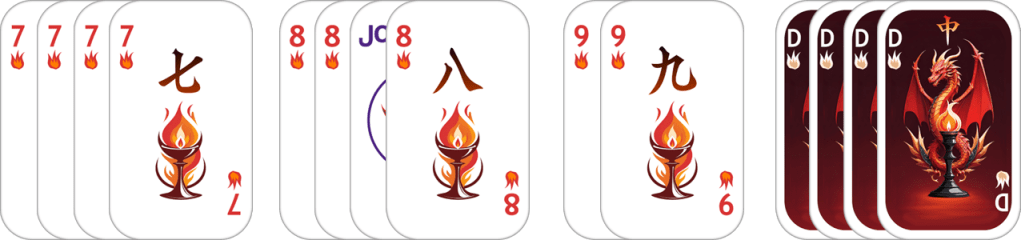
EXAMPLE SPECIAL HANDS:


DOUBLING: A unique feature of 2-Player Mint Tin Mahjong is the doubling rule. Once you have a valid winning hand, even if it is worth 0 points, you can call “Double” instead of “Mahjong”, as long as there are at least 3 cards remaining in the draw deck. If your opponent declines the double by saying “drop”, the round ends and you earn the points that your hand is worth, or 1 point if your hand is worth 0. If your opponent accepts the double, they say “take”. At this point, you take no more turns. Your opponent takes 3 more turns, first drawing a card, then discarding a card face down to track how many turns they have taken. If your opponent does not complete a winning hand within those three turns, you double the points you earned from the hand you created, or if your hand is worth 0 points then you earn 1 point. If your opponent does complete a winning hand, even one worth 0 points, in those three turns then they win double the amount of the highest value hand, either yours or theirs. If both players have a winning hand worth zero points, then the opponent gains 1 point. Doubling is a great way to win on a hand that would otherwise be worth 0 points, however it is a gamble, so it must be used strategically.
MISCALLED MAHJONG: If you call Mahjong, but do not have a valid winning hand, the round stops and your opponent scores 2 points. In a friendly game, especially when first learning the game, players can elect to just continue playing the round instead of applying the penalty.
WINNING THE GAME
The first player to reach 7 points wins the game. The score cards provided track up to 7 points. To play a longer game, players can elect to play a “double” game to 14 points by turning their cards to 0 once they reach 7 points, and playing for an additional 7 points. The special EPIC HAND is worth 7 points, so if you ever achieve that special hand, you automatically win the game!
SETUP FOR ONE PLAYER SOLO MODE
This is a solo game, however you will be playing against a virtual opponent. Pretend that your virtual opponent is sitting across from you. These rules will refer to your opponent’s area, meaning an area at the top of your playing area away from your hand and exposed tile area.
- Set the score cards to the side with one on your side and one on your opponent’s side. Turn both cards so the zero is at the top of the card when read by the player the card belongs to.
- Set the two jokers aside, then shuffle all the remaining cards.
- Set the jokers aside, then shuffle all the remaining cards.
- Deal 12 cards each to you and your opponent. You can look at your cards but not your opponent’s cards.
- Place your opponent’s cards aside in a pile called the “Dead Hand”. These cards will not be used in the round.
- Place the rest of the cards face down in a “Draw Deck”.
- Add one of the jokers to your hand.
- Place your opponent’s joker next to and above the draw deck.
- Leave space for a “Discard Row” to the right of the opponent’s joker where all discards will be placed.
- Leave space for a row to the right of the draw pile where your opponent’s exposures will be placed.
- Leave room on the left of the draw deck for the opponent’s “hold spot” (explained below).
- Leave additional room in front of you for cards you expose during the round.
- Organize your hand how you would like and you are ready to start.

GAMEPLAY OBJECTIVE:
Just like the two-player game, your goal is to create a valid Mahjong hand by forming a valid pattern of card groupings totaling 14 cards, while following a valid category of card ranks.
TAKING YOUR FIRST TURN: You will always take the first turn of every round. You start by drawing one card from the draw deck and adding it to your hand. Then, select any one card from your hand and discard it face up to the discard row. This ends your turn.
YOUR OPPONENT’S FIRST TURN: Draw a card from the draw deck and place it in the opponent’s “hold spot”. This card represents both a drawn tile and a discard by your opponent. Before placing it in the discard row, you have the opportunity to “call” this card (see below). If you do not call the card, then the card is placed in the discard row.
CALLING A CARD: To call a card, place it face up in your “exposures” area along with at least two other identical cards or jokers. Then discard a card from your hand to the discard row. This counts as your turn, and now your opponent takes the next turn.
YOUR EXPOSURES: Once you have called a card, placed it with at least 2 cards from your hand into the exposures row, and discarded a card to end your turn, your exposure is set and cannot be changed. You cannot add to or take cards away from an exposure once you discard to end your turn. You also cannot discard an exposed card.
OPPONENT’S EXPOSURES: If at any time there is a joker in the opponent’s joker spot and a card is discarded that is identical to at least one other card in that discard row, both the cards and the joker are placed together in the opponent’s exposures row creating an “exposed Pung”. If there is no joker in the opponent’s joker spot, then any time a card is discarded with two other identical cards already in the discard row the three cards are placed together in the opponent’s exposure row making another “exposed Pung”. Your virtual opponent can make exposures after you discard a card or after the card is discarded from the hold spot during your opponent’s turn. Regardless, after any exposure by your opponent, the next step is for you to draw a card for your next turn.
EXAMPLE OPPONENT EXPOSURE: A 2-Bamboo is discarded. Because another 2-Bamboo has previously been discarded, and a joker is in the opponent’s joker spot, an exposure needs to happen. Place the joker and the two 2-Bamboo tiles together as a Pung in the opponent’s exposures row.

JOKER SWAPS: Either you or your opponent can perform a joker swap on their turn. If a player has an exposure that includes a joker, and a player has the card that the joker is replacing, they can swap their card for the exposed joker. You can swap with yourself or your opponent, and your opponent can swap with you or themselves. This works slightly differently if you or your opponent are swapping a joker.
YOU SWAP: After you draw a card but before you discard a card, take the joker from any exposure where you have a matching card, put the joker in your hand, then replace it with the appropriate card in the exposure. You then discard any card to end your turn.
OPPONENT SWAP: When a card is placed in the opponent’s hold spot on their turn, if that card can replace a joker in any player’s exposures, place the card in that exposure and place the joker card in the opponent’s joker spot. At that time, if there are any two card that are identical in any discard row, place them with the joker in the opponent’s exposures row. If there are more than one set of matching cards already discarded, then select based on the following priority order: Green Dragon, White Dragon, Red Dragon, whichever is the lowest number. After the opponent makes a joker swap and/or exposure, you draw a card for your turn.
CALLING MAHJONG: If after drawing or calling a card on your turn, the 14 cards in your hand make a valid pattern and use a valid category set, and score at least 1 point, you can call Mahjong. Normally you cannot call a card to make a pair, however if the card is the last card you need to make a Mahjong hand, you can call that card to make a pair. Once you call Mahjong, the round immediately ends and you mark your score using your score card by turning it to the appropriate number.
SCORING IF YOU WIN: Scoring your winning hands follows the same procedure as described in the 2 player version above.
OPPONENT WINS THE ROUND: Once your opponent has exposed 5 Pungs, the round ends and they score 1 point. In addition, they score 1 point for each dragon Pung they exposed that matches the suit of another number Pung they exposed.
WALL GAME: If neither player reaches their win condition after the last card is drawn and a discard is made, then the round ends with zero points for either player. A defensive strategy can be to try to make it to a wall game when you see that you are likely not going to win but your opponent is close.
DOUBLING: In the solo version of the game, doubles work similarly to the two player version, however only you can double. Once you have a valid winning hand, even if it is worth 0 points, you can call “Double” instead of “Mahjong”, as long as there are at least three cards remaining in the draw pile, and your opponent has exposed at least three Pungs. At this point, you take no more turns. Separate three cards from the draw pile. Your opponent will take three more turns using these three cards. One at a time, turn each card face up and immediately place it in the discard row. If the card can make an exposure, then make the exposure. If your opponent doesn’t make a fifth Pung after these three turns, then you win double the points you earned from the hand you created, or if your hand is worth 0 points then you earn 1 point. If your opponent does complete five Pungs in those three turns then the opponent wins double the value of their hand points. Doubling is a great way to win on a hand that would otherwise be worth 0 points, however it is a gamble, so it must be used wisely.
WINNING THE GAME: The first player to reach 7 points wins the game.
OPTIONAL RULES: Play with one or both of these rules to add variety to your gameplay and dial in the level of challenge you prefer:
- DEAD HAND: Use fewer or no cards in the dead hand. You have more time to build hands, but it is very hard to force a “Wall Game” defensively.
- JOKER BLOCK: You can choose to place a joker in the discard row, which stops any cards before that joker from being eligible to be used in an exposure. You do not gain a point for this discard, but it can save you from losing the round.
 John Burton Games